Phase unwrapping without ground truth
Ph.D., DIRO, Université de Montréal · since 2024
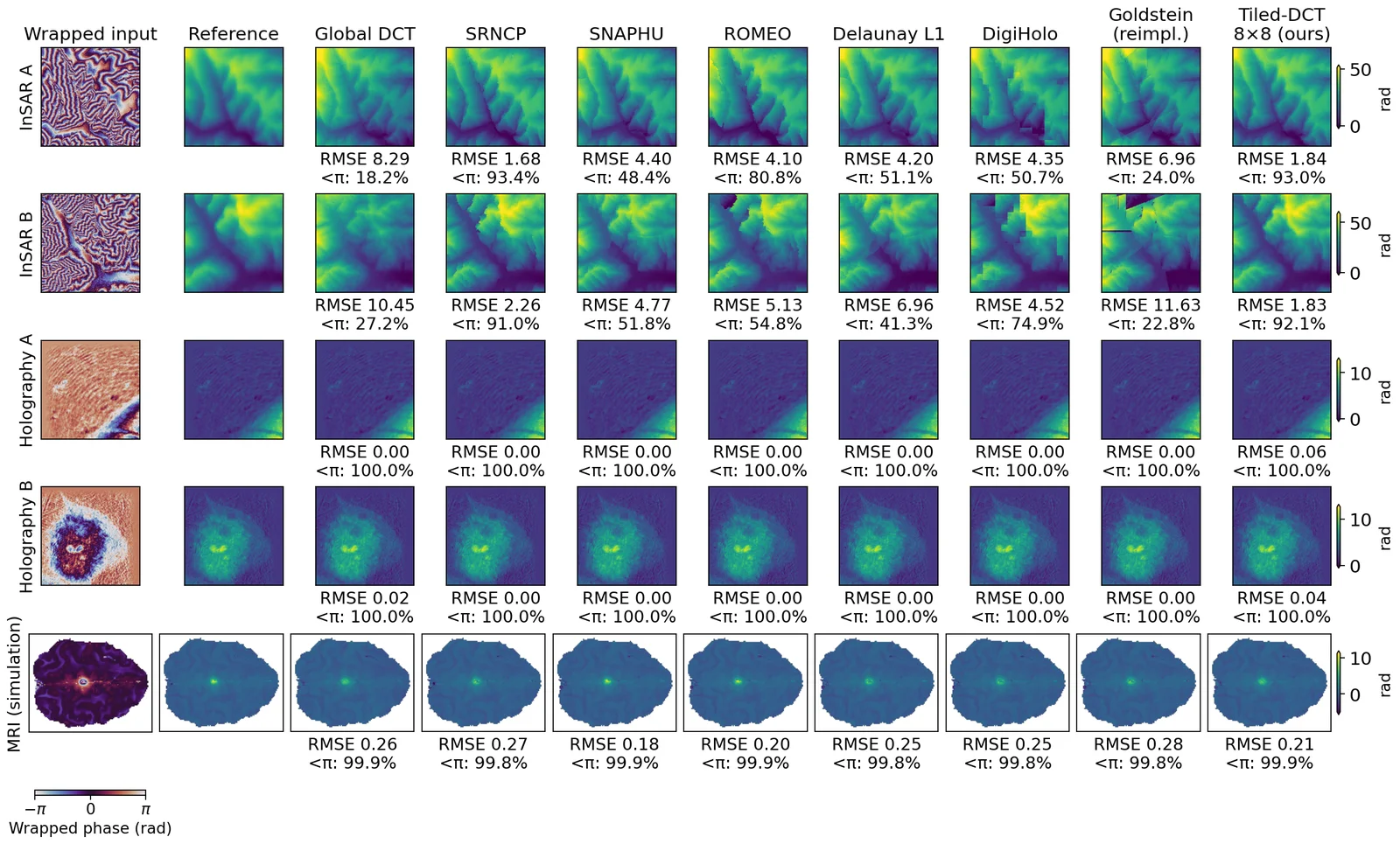
Phase unwrapping is a key step in interferometric and coherent imaging: interferometric radar (InSAR), MRI, holography, optical metrology. The instrument delivers the phase only modulo 2π. The missing cycles must be recovered, separating the jumps caused by wrapping from those produced by noise, true discontinuities or under-sampling.
My thesis addresses this problem when no ground truth is available. A first, tile-based method combines local spectral reconstruction, reliability-ordered tile joining and residual-weighted multipath averaging. Each tile is reconstructed by discrete cosine transform least squares, while robust border measurements guide their assembly along a spanning tree.
The reconstruction is repeated over shifted grids, rotations and reflections, which vary tile boundaries and joining paths. Residual-weighted averaging combines the resulting passes, computed in parallel and accumulated on the fly.
We also introduce the corrected circular rewrapping error, a phase-congruence measure that quantifies departures from the observed phase modulo 2π, even on experimental acquisitions without an unwrapped reference. On radar-interferometric, magnetic-resonance, holographic and constructed phase images, against seven reference algorithms, the method achieves the lowest mean fraction of pixels with errors exceeding π among methods completing the full evaluation. It lies on several measured speed–accuracy Pareto fronts.
A second report studies adaptive tiling with quadtree and kd-tree partitions. Adaptive partitions use fewer tiles but remain slower than the optimized grid: building the partition and solving larger tiles outweighs the savings at tile boundaries.
The next stage of the thesis addresses deep learning without unwrapped reference phase, through masking-based training inspired by Noise2Void.
Publications and links
- Preprint, arXiv, 2026 — Tile-Based Phase Unwrapping with Reliability-Ordered Joining and Residual-Weighted Multipath Averaging
- Technical report, arXiv, 2026 — Adaptive Tiling for Least-Squares Phase Unwrapping: Runtime and Accuracy